
Israelite Soloist II
The Israelite Soloist II is the voice that remains when the shouting stops.
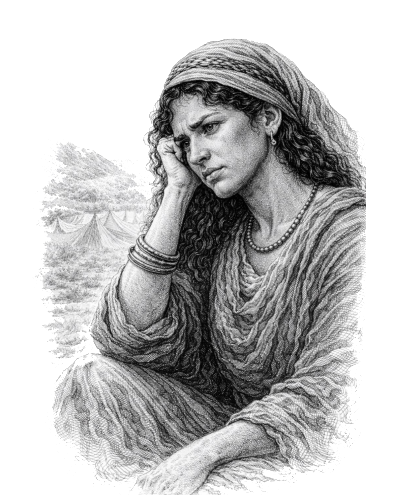
Where celebration surges and bodies move in triumph, this Soloist steps into stillness. They embody the emotional aftermath of liberation, the moment when freedom arrives faster than healing, and joy collides with memory. This character does not challenge the journey forward. They ask what the journey has already cost.
Israelite Soloist II represents the inner reckoning of a people who have crossed the sea but have not yet crossed themselves.
This Soloist is not driven by momentum like Israelite Soloist I. They are driven by reflection. Their voice is quieter, slower, and weighted with lived experience. They speak from the shoreline, not the center of the dance. Their power lies not in volume, but in honesty. They are the voice that dares to say that deliverance is real and still incomplete.
Where celebration surges and bodies move in triumph, this Soloist steps into stillness. They embody the emotional aftermath of liberation, the moment when freedom arrives faster than healing, and joy collides with memory. This character does not challenge the journey forward. They ask what the journey has already cost.
Israelite Soloist II represents the inner reckoning of a people who have crossed the sea but have not yet crossed themselves.
This Soloist is not driven by momentum like Israelite Soloist I. They are driven by reflection. Their voice is quieter, slower, and weighted with lived experience. They speak from the shoreline, not the center of the dance. Their power lies not in volume, but in honesty. They are the voice that dares to say that deliverance is real and still incomplete.
Musically, Israelite Soloist II leans into breath-led melody, intimate
phrasing, and spoken-sung confession. Their style draws from soul,
gospel lament, and poetic reflection rather than rhythmic fire. Where
Soloist I uses rap to break chains, Soloist II uses silence to examine what
remains once the chains are gone.
This character does not perform for the crowd. They speak to the water, to memory, to God, and to themselves.
Emotionally, Israelite Soloist II embodies sacred grief and mature courage. They are not weak. They are brave enough to feel. They carry the weight of loss without letting it pull them backward. Their sorrow is not nostalgia for bondage. It is reverence for truth. They understand that to forget Egypt entirely would be to fracture the soul, and that remembrance is not disobedience, but integration.
Dramatically, the Soloist serves as the emotional counterbalance to triumph. Their presence deepens the narrative by grounding victory in reality. They remind the audience that freedom reshapes identity, and that identity does not change without mourning what came before. Through them, the story refuses to simplify liberation into spectacle.
Israelite Soloist II is the first voice to articulate that survival has a cost, and that faith sometimes walks forward carrying unanswered questions.
This character does not perform for the crowd. They speak to the water, to memory, to God, and to themselves.
Emotionally, Israelite Soloist II embodies sacred grief and mature courage. They are not weak. They are brave enough to feel. They carry the weight of loss without letting it pull them backward. Their sorrow is not nostalgia for bondage. It is reverence for truth. They understand that to forget Egypt entirely would be to fracture the soul, and that remembrance is not disobedience, but integration.
Dramatically, the Soloist serves as the emotional counterbalance to triumph. Their presence deepens the narrative by grounding victory in reality. They remind the audience that freedom reshapes identity, and that identity does not change without mourning what came before. Through them, the story refuses to simplify liberation into spectacle.
Israelite Soloist II is the first voice to articulate that survival has a cost, and that faith sometimes walks forward carrying unanswered questions.
Symbolically, the Israelite Soloist II represents:
Vocally, the role requires restraint, emotional clarity, and profound control. The performer must sing as if confiding a truth they have never spoken aloud. The voice should feel close, human, and unguarded. Breath is as important as pitch. Silence is as powerful as sound. This is not a showcase role. It is a revelation role.
Israelite Soloist II marks the moment when Exodus stops being only a story of escape and becomes a story of transformation. Their presence allows the audience to exhale, reflect, and recognize themselves in the quiet spaces between victory and uncertainty
- The inner voice of the liberated
- The memory that travels with freedom
- The grief that must be honored to heal
- The honesty that follows triumph
- The spiritual maturity of a people awakenin.
Vocally, the role requires restraint, emotional clarity, and profound control. The performer must sing as if confiding a truth they have never spoken aloud. The voice should feel close, human, and unguarded. Breath is as important as pitch. Silence is as powerful as sound. This is not a showcase role. It is a revelation role.
Israelite Soloist II marks the moment when Exodus stops being only a story of escape and becomes a story of transformation. Their presence allows the audience to exhale, reflect, and recognize themselves in the quiet spaces between victory and uncertainty
They do not lead the people forward.
They walk beside them.
Holding memory in one hand.
And hope in the other