
Hebrew Mothers
The Hebrew Mothers embody the emotional core of the Israelite community. They carry the weight of generational trauma, the fear of losing their children, and the hope that refuses to die even in the harshest conditions. Their presence in the musical is not symbolic alone. They are the heartbeat of the people. Their grief gives depth to the stakes of oppression, and their courage gives shape to the meaning of deliverance.
These women live in a world where their sons are hunted, their daughters are burdened, and their husbands are beaten under the sun. Their lullabies are whispered through trembling breath. Their prayers rise from cracked lips and aching bones. Their arms hold both life and fear. Their strength is not gentle by default. It is fierce, protective, and born from necessity.
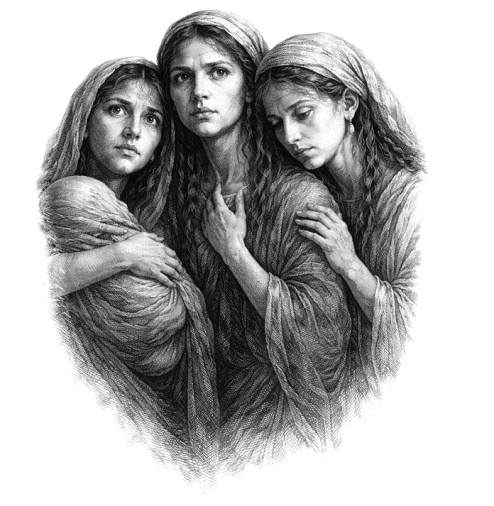
In the scenes surrounding the decree of Pharaoh, the Hebrew Mothers become the central voices of terror and resistance. They cry out with raw pain, question the injustice around them, and cling to faith in unspeakable circumstances. When Moses is placed in the Nile, it is through the hands, tears, and trembling hope of a mother who chooses destiny over despair.
Musically, the Hebrew Mothers carry the spiritual lament of the people. Their harmonies reflect ancient mourning traditions. Their melodies
tremble under the weight of sorrow. Their voices add emotional texture to moments of fear and tenderness. They represent not only individual
women but the collective suffering of the enslaved, and the immeasurable cost of freedom.
Choreographically, their movement is grounded and fluid, often shaped by gestures of cradling, releasing, and reaching. They symbolize nurture,
loss, desperation, and resilience. Their physicality contrasts the militaristic rigidity of the Egyptians and the prophetic intensity of Moses and Miriam.
The Hebrew Mothers are not background characters. They are the emotional frame of the story. Through them, the audience feels the cost of Pharaoh’s cruelty and the sacredness of Israel’s deliverance. They are the ones who show that liberation is not merely political. It is deeply personal.
The Hebrew Mothers are not background characters. They are the emotional frame of the story. Through them, the audience feels the cost of Pharaoh’s cruelty and the sacredness of Israel’s deliverance. They are the ones who show that liberation is not merely political. It is deeply
personal.
Hebrew Mother 1
Hebrew Mother 1 is the first voice to break through the silence i moments of crisis. She confronts the terror of Pharaoh’s decree with
trembling honesty and becomes one of the earliest figures to articulate the grief of the community. Her fear is visceral, but so is her instinct to protect. She is a woman who communicates devastation with clarity and truth. She sets the emotional tone for the danger facing the children of Israel.
Vocally, her tone is warm but strained, reflecting the exhaustion of motherhood in bondage. She provides some of the earliest lament textures that resonate through the musical.
Vocally, her tone is warm but strained, reflecting the exhaustion of motherhood in bondage. She provides some of the earliest lament textures that resonate through the musical.
Hebrew Mother 2
Hebrew Mother 2 carries the emotional thread of questioning and anxiety. Her lines often reveal the uncertainty of survival and the helplessness felt when the world crumbles around her. She is the voice that asks what others are afraid to say. She embodies the psychological toll of oppression. Her vulnerability deepens the audience’s understanding of what Israel endured. Musically, her voice carries a trembling clarity that communicates both
fear and a flicker of endurance.
Musically, her voice carries a trembling clarity that communicates both fear and a flicker of endurance.
Hebrew Mother 3
Hebrew Mother 3 stands at the moment when grief becomes courage. She is the mother who asks why the river is chosen, why hope must be entrusted to water, and why her child must face such risk. Her presence in the scene with the Nile is crucial. Through her, the audience experiences the full emotional cost of releasing a child into the unknown.
She represents painful sacrifice, desperate faith, and the moment when a mother must trust God with what she cannot protect. Her vocal quality is rich and resonant, adding depth to ensemble harmonies and intensifying emotional scenes with grounded, aching tone.
These women together form the emotional anchor of the early narrative. Their grief becomes the seed of Israel’s longing for freedom. Their hope
becomes the soil in which courage grows. Their love becomes the force that the empire cannot break. Without the Hebrew Mothers, the story of Exodus would lack its heartbeat.