
Hebrew Fathers
The Hebrew Fathers represent the dignity, endurance, and quiet anguish of a people forced to labor beneath the weight of empire. Their voices reveal the emotional burden carried by men who must navigate a world where their strength is exploited, their leadership suppressed, and their families threatened at every turn. They live in the tension between powerlessness and responsibility, between fear for their children and the need to remain strong for their households.
These men do not have the privilege of open defiance. Their resistance is internal, hidden beneath layers of exhaustion and restraint. Their agony is not expressed through rage alone, but through the collapse of hope in their eyes, the heaviness in their breath, and the tremor in their voices when Pharaoh’s decree steals away the innocence of the next generation.
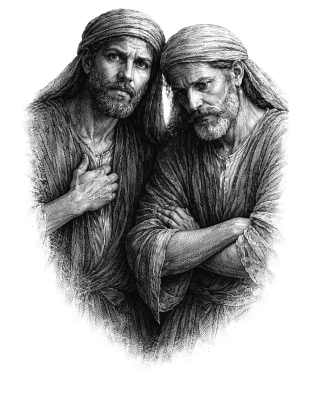
The Hebrew Fathers give the audience a window into the emotional landscape of men who must bury their pride in order to survive. They mourn the loss of agency. They fear the loss of their sons. They feel the crushing guilt of being unable to protect their families. Yet beneath the sorrow lies a deep faith that refuses to fully extinguish. They carry the ancient spiritual instinct to pray even when prayer feels futile, to hold their families close even when safety seems impossible, and to stand with each other even when strength feels scarce.
Musically, the Hebrew Fathers carry lower harmonies that ground the ensemble. Their voices deepen the lament of early scenes and give weight to the chants of despair and trembling resilience. When they speak, the tone is roughened by dust, labor, and grief. When they sing, their lines hold a solemnity that anchors the emotional scope of the Hebrew community.
Choreographically, their presence is heavy, deliberate, and rooted. Their movement reflects the physical fatigue of labor and the emotional burden of living under tyranny. Their bodies tell the story of years spent bent beneath stone and lash, yet still able to rise when faith demands it.
The Hebrew Fathers remind the audience that freedom is not only the longing of the oppressed, but the burden of those who must watch helplessly as oppression threatens the future of their families. They stand as evidence that courage often hides in silence, and that faith can survive even in the hearts of men who feel broken.
Below are the individual roles within this group:
Hebrew Father 1
Hebrew Father 1 is a man caught between terror and responsibility. His lines often express the raw urgency of crisis. He is the first to give voice to the nightmare unfolding when Pharaoh’s soldiers enter the Hebrew quarter. He speaks with the protective instinct of a father who fears he cannot shield his children from what is coming. His words tremble with the weight of generational trauma and immediate danger.
Vocally, he carries a resonant tone infused with desperation. His spoken lines pierce through chaos, offering a pointed and emotional reflection
of what fathers faced under Pharaoh’s decree.
Hebrew Father 2
Hebrew Father 2 embodies a quieter sorrow. His lines often reveal a reflective grief, as though he has seen too much loss to hope easily. He does not shout first. He speaks from the numbness of heartbreak. His character represents the long-term psychological toll of systemic oppression and the silent endurance required to survive it. When he does raise his voice, it carries monumental emotional force.
Musically, his tone is subdued but solid, often adding lower harmonies that shape the depth of ensemble lament. His presence gives the audience a sense of the weight that Hebrew men carried each day.
Together, the Hebrew Fathers deepen the story of Israel’s suffering. They show that oppression does not fall only on the laborers’ backs, but on the hearts of those who must protect the vulnerable without the means to do so. Their fear becomes part of Israel’s cry for deliverance. Their
endurance becomes part of Israel’s strength. Their quiet faith becomes a seed planted in the hearts of the generation that will one day cross the
sea.