
Hebrew Workers
The Hebrew Workers embody the physical suffering and endurance of the Israelite community under Egyptian bondage. They represent the men and women whose days begin before sunrise and end long after twilight, whose backs bear the marks of oppression, and whose labor built the empire that dehumanized them. They form the backbone of the opening scenes and serve as a constant reminder of the story’s stakes.
These characters move through the world with bodies shaped by toil and spirits shaped by survival. Their voices carry the dry dust of quarries, the burning weight of brickmaking, and the unspoken fear that each day may bring new cruelty. Yet within their exhaustion lies a spark: an ember of
hope, a longing for deliverance, a quiet resilience passed down through whispered prayers in the night.
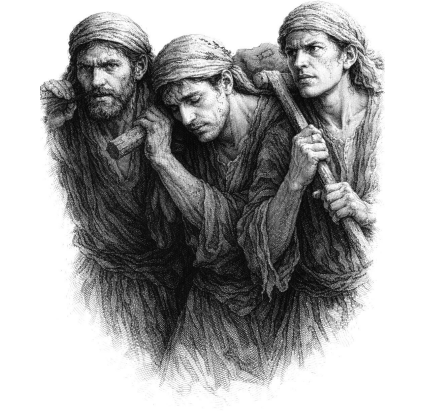
The Hebrew Workers speak with raw honesty. Their lines articulate the daily brutality of forced labor and the emotional fatigue of living in a world that crushes their dignity. They express the sorrow of chained identity, the humiliation of being treated as property, and the growing tension between despair and hope. They help the audience understand the enormity of what Israel endured and what liberation truly means.
Vocally, the Hebrew Workers contribute rhythmic chants, percussive breathing, harmonic grounding, and spoken word lines that beat like the pulse of a nation. Their voices are earthy and resonant, often driving the ensemble’s tempo in scenes of oppression or unrest. They help shift the musical landscape between lament, tension, and uprising.
Choreographically, their movement is weighted and deliberate, shaped by years of labor. They embody heaviness, repetition, and the muscle memory of hardship. But their physicality also transforms as the story progresses. When freedom approaches, their movement loosens and expands. They rise with the promise of deliverance.
The Hebrew Workers are essential to the storytelling. They represent the everyday people for whom the Exodus miracle mattered most. They show that deliverance is not abstract. It is breath restored to tired lungs. It is dignity returned to scarred backs. It is hope rekindled in hearts that
have known too much darkness.
Below are the individual roles within this group:
Hebrew Worker 1
Hebrew Worker 1 is often the first to speak truth about the labor conditions. His lines reveal the pain of endless toil and the collective frustration of a people whose lives are consumed by the demands of empire. His voice is roughened by dust and work, carrying the emotional weight of someone who has spent too many years bent beneath stone.
He sets the tone for many early scenes, articulating the exhaustion, bitterness, and longing that define the Hebrew experience. When he speaks, the audience feels the heaviness of slavery in a tangible way.
Vocally, he offers grounded spoken word and chant-driven delivery, contributing to the musical’s earthy, percussive texture.
Hebrew Worker 2
Hebrew Worker 2 embodies the introspective dimension of suffering. His lines reveal confusion, fear, and the psychological toll of forced labor. He represents those who have learned to question quietly, to hope cautiously, and to endure silently. His expressions of identity struggle
deepen the emotional layering of scenes such as Moses’s emergence and the rising tensions within the community.
Musically, his voice supports lower harmonics and syncopated rhythms, adding depth to ensemble textures.
Hebrew Worker 3
Hebrew Worker 3 brings a slightly sharper edge to the group. His lines often challenge or probe, pushing back against complacency. He may be the one who calls attention to injustice that others have accepted as normal. His presence introduces friction that reveals the emotional strain within the enslaved community. He is bold enough to voice what many feel: frustration, disbelief, and the yearning for change.
Vocally, he delivers tight rhythmic patterns, fast spoken word segments, and harmonic accents that sharpen the emotional stakes of group scenes.
Together, the Hebrew Workers form the laboring chorus of the musical. They are the ones whose sweat waters the soil of Egypt, whose bodies carry the scars of empire, whose memories hold the grief of generations, and whose voices rise into the cry that God answers.
They are the oppressed whose tears become the spark of deliverance. They are the weary whose footsteps will one day cross the sea.
They are the proof that liberation begins with those who refuse to let their suffering silence them.