
Pharoah’s Guards
Pharaoh’s Guards are a group of six to eight elite performers who embody the physical power of Egypt. They speak through movement rather than words, using stomp-driven choreography, precision formations, and unified rhythm to enforce Pharaoh’s authority. Their silence throughout most of the musical is intentional. It reflects a force trained to obey without question, to dominate without hesitation, and to project intimidation through discipline alone. Their bodies, not their voices, communicate the ideology of empire.
These Guards move with geometric exactness. Their lines are straight and unforgiving. Their formations are rigid and deliberate, mirroring the order Egypt imposes on its people. Every stomp, chest hit, and staff strike reverberates like a declaration of control. When they hit the floor,
the stage seems to brace. Their presence tightens the air. They are the muscle of tyranny, the shadow behind Pharaoh’s throne, and the constant reminder of Israel’s oppression.
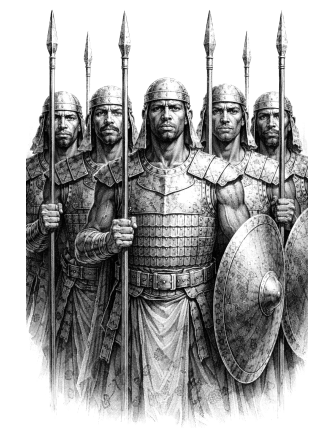
They appear throughout the story as the silent pillars of Pharaoh’s rule. In “God Among Men,” their stomp rhythms amplify his delusion of divinity, turning the throne room into a battlefield of dominance. In “Hunt Them Down,” their sharpened pace becomes the physical embodiment of Pharaoh’s grief and rage. Their devotion appears absolute, their formation unbreakable.
Yet the Red Sea reveals the truth behind their power. As the waters rise, their synchronized strength falters. Their lines break. Their breath
quickens. Movement that once projected certainty dissolves into chaos. Without speaking a word, the Guards show the unraveling of an empire undone by its own pride. Their collapse symbolizes the fall of the system they upheld.
In “The Last Line,” the Guards join the music vocally for the first and only time. Their chants are low and resonant, carved like stone. They do not sing melody. They deliver rhythm. Their unified voices encircle Pharaoh as the sea prepares to fall, creating a haunting soundscape of a kingdom taking its final breath.
This final sequence becomes a choreographic countdown. Each bar ends with a single explosive stomp, and each stomp blacks out another pair of Guards. The formation shrinks until only one remains, then none. Their disappearance marks the complete collapse of Egyptian power, leaving Pharaoh alone to speak his final words.
Symbolically, Pharaoh’s Guards represent:
- The silent hands of tyranny
- The illusion of invincible strength
- The machinery that enforces fear
- The structure that collapses when truth confronts it
Their silence is intimidation.
Their stomp is authority.
Their chant is the last echo of a dying empire
Even without traditional dialogue, Pharaoh’s Guards hold dramatic power equal to any speaking role. They turn percussion into character. They turn movement into worldbuilding. They make the fall of Egypt feel physical and inevitable. Their collapse marks the breaking of th empire itself.