
General Ensemble
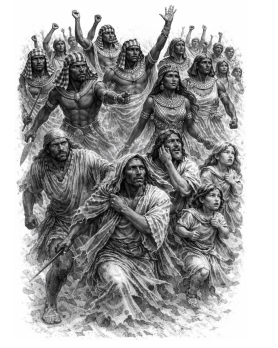
The General Ensemble is the living landscape of the musical. They transform the stage into Egypt’s throne rooms, Israel’s labor camps, the banks of the Nile, the trembling wilderness, and the parted waters of the Red Sea. Their bodies, voices, rhythm, and breath carry the emotional architecture of the story. They do not stand behind the narrative. They move within it. They shape it. They give it pulse.
This ensemble is not a single group, but a fluid collective that shifts identities seamlessly. In one moment, they are Hebrew workers crushed beneath the weight of oppression. In another they are Egyptian civilians trembling under the plagues. They become mothers and fathers, guards and citizens, artisans and scribes, elders and children. Their versatility allows the world of Exodus to expand and contract with cinematic
precision.
Musically, the Ensemble provides the foundation of the score. They chant, hum, whisper, shout, and sing in layered harmony. They create atmospheric soundscapes, rhythmic percussive textures, and gospelinfused crescendos. Their voices rise in lament, build into protest, and explode into celebration. They echo Moses’s courage, amplify Miriam’s rhythm, and heighten Aaron’s compassion. Through them, the emotional impact of every scene deepens.
Choreographically, the Ensemble is the centerpiece of physical storytelling. Their feet strike the ground in stepping sequences. Their hands clap, sweep, pull, and reach. They sway as one body or fracture into shifting clusters. They become the Nile’s current, the chains of bondage, the breath of God moving through the desert, and the towering walls of the Red Sea. Their movement language blends African diaspora forms, ritual gesture, modern theatricality, and symbolic embodiment.
The Ensemble’s presence ensures that every moment feels communal. Exodus is not the story of one man or one family. It is the story of a nation. When the Ensemble laments, the audience feels the sorrow of captivity. When they panic, the tension thickens. When they march, the air lifts. When they rejoice, the entire theater rises with them. Their transformation from oppressed laborers to free worshippers is one of the musical’s most powerful arcs.
Thematically, the Ensemble represents:
- The collective memory of the oppressed.
- The endurance of a people tested beyond measure
- The human cost of empire.
- The spiritual hunger for deliverance
- The courage that emerges in community
- The breath of a nation rising toward promise.
Their voices do not merely accompany the principals. They complete them.
Their movement does not simply support scenes. It defines them.
Their presence does not fade into the background. It expands the world.
The General Ensemble is the heartbeat of the musical.
They carry the suffering and the triumph.
They hold the fear and the hope.
They embody both the brokenness of Egypt and the rebirth of Israel.
Without them, the story would exist.
With them, it comes alive.