
Egyptian Artisan
The Egyptian Artisan represents the skilled laborers, craftsmen, and creators who built the visible glory of Egypt while remaining invisible within its hierarchy of power. His voice emerges during one of the most emotionally charged sequences in the musical, “Ashes in the Throne Room,” where he becomes the conscience of a collapsing empire. He speaks not as a soldier or a noble, but as an ordinary man who shaped Egypt’s grandeur with his hands and must now watch that grandeur
crumble under the weight of its injustice.
The Artisan’s perspective is essential. He is neither innocent nor fully complicit. He has contributed to the magnificence of Pharaoh’s world, carving idols, polishing statues, and building structures meant to reflect divine and royal authority. Yet he has also lived with the uncomfortable truth that such beauty was built on broken backs and crushed spirits. His rap lines reveal a man caught between pride in his craft and guilt over the suffering woven into every stone he touched.
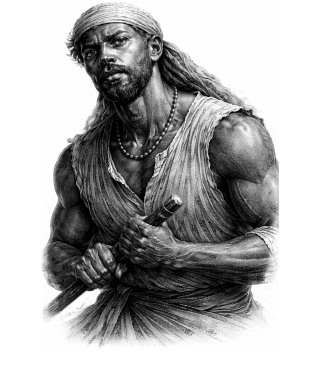
His verse exposes the contrast between the empire’s carefully curated image and the hidden cost borne by enslaved labor. He names what Egypt has long refused to confront. He admits that the gods he carved were lifeless. He confesses that no monument ever engraved the names of the children who died in bondage. His words drip with shame and awakening. They represent a social reckoning that rises from within the heart of Egypt itself.
Vocally, the Artisan’s rap delivery is sharp, rhythmic, and emotionally punctuated. He spits truth like chisels striking stone. His lines carry bitterness, clarity, and sorrow. He speaks with the cadence of someone who has spent years laboring in silence and suddenly finds his voice under the pressure of judgment. His verse is not rebellion. It is revelation. It is the sound of a man seeing his world for the first time.
Dramatically, the Artisan stands as a counterpoint to Pharaoh. Where Pharaoh clings to the illusion of divine authority, the Artisan confronts the reality that Egypt’s foundations were corrupt. His presence adds nuance to the Egyptian narrative. He reminds the audience that even in oppressive systems, there are individuals who begin to question, doubt, and grieve the suffering around them.
Symbolically, the Artisan represents:
- The moral conscience buried within empire
- The creators whose art was used to justify oppression.
- The awakening of truth inside a collapsing world.
- The ordinary citizen suddenly confronted with divine judgment.
- The internal fracture of Egypt’s cultural identity
His verse is not just commentary. It is confession. It allows the audience to see Egypt not only as the villain of the story, but as a nation filled with human souls who must now face the consequences of decisions made by those in power.
The Artisan’s role widens the scope of the story. He reveals that oppression is not upheld solely by kings. It is enforced by systems, cultures, traditions, and often by good people who never questioned the shape of their world. When plagues strike and the throne room fills with ashes, the Artisan’s words carve honesty from ruin.
He is the craftsman of Egypt’s beauty, now testifying against the corruption beneath it.
He is the voice of a nation waking up too late.
He is the mirror Egypt never asked for, reflecting a truth it can no longer deny.