
Egyptian Ensemble
The Egyptian Ensemble gives voice and body to the world of Egypt as it rises in pride, trembles in judgment, and ultimately collapses under the weight of its own certainty. They are not merely the counterpart to the Israelite Ensemble. They represent the ordinary people living inside an empire that believed itself unshakable. Through them, the audience witnesses the human cost of Pharaoh’s defiance and the emotional unraveling of a nation facing divine confrontation.
The Egyptian Ensemble shifts identities throughout the musical: citizens, workers, nobles, parents, mourners, worshippers, and fearful witnesses. Their spoken lines in “Plagues” reveal a community grappling with shock, grief, and disbelief as their world decays around them. Their voices tremble as darkness falls. Their cries crack as livestock dies. Their chants break apart as boils spread, as hail fire strikes the land, as locusts consume what remains. They do not speak with the authority of the throne. They speak with the anguish of those who must live under the consequences of decisions they did not make.
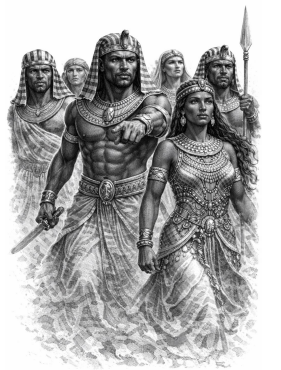
Musically, the Egyptian Ensemble stands in stark contrast to the Israelites. Their harmonies are tighter, more strained, often dissonant. Their chants during the plagues are fragmented and panicked. Their voices often sit lower in the register, weighted by fear. They do not rise in unity. They shatter. Their sound fractures as their society fractures. Where the Israelite Ensemble grows stronger with every scene, the Egyptian Ensemble grows more desperate, more exhausted, more broken.
Choreographically, the Egyptian Ensemble moves with a language centered around tension, collapse, and recoil. Unlike the unified steps of Pharaoh’s Guards, their movement is reactive and chaotic. They shield themselves from unseen forces. They grasp at stability. They spin into disarray as plagues strike. Their bodies reflect the psychological dissolution of a community that has always believed in the permanence of power. In “Ashes in the Throne Room,” their presence becomes a ritual of mourning, lament, and collective reckoning.
Thematically, the Egyptian Ensemble represents:
- The human cost of empire
- The innocence caught between rulers and judgment
- The collapse of cultural certainty
- The suffering of a people who believed they were protected
- The fear that arises when the world no longer behaves as expected
- The echo of systems built on exploitation
Their presence ensures that Egypt is not depicted as a faceless antagonist. It becomes a real society filled with real people who bleed, grieve, and fear. Their suffering in the plagues scenes deepens the tragedy and complexity of the narrative. Their cries offer a glimpse into the fragility of human power and the devastation wrought by leaders who refuse humility.
In the climax of the story, their silence becomes haunting. After the tenth plague, the Egyptian Ensemble does not sing in triumph. They sit in the ashes of their nation. Their absence or stillness becomes a powerful emotional texture that allows the audience to feel the depth of Egypt’s loss.
Symbolically, the Egyptian Ensemble shows that judgment does not fall on rulers alone. It radiates through the structures and lives built beneath them. They remind us that injustice harms everyone connected to it. They embody the sorrow of a nation brought low by its own pride and the unchecked authority of its king.
The Egyptian Ensemble enriches the tapestry of the musical. Through them, Egypt becomes more than a place. It becomes a world that rises, cracks, and collapses. Their cries, movement, and presence mirror the themes of illusion and awakening that echo throughout the story.
They are the grief beneath the throne.
They are the fear behind the chariots.
They are the human shadow of Pharaoh’s pride.
And when Egypt falls silent, their silence reverberates across the stage like the echo of a kingdom that could not stand against truth.