
Egyptian Scribe
The Egyptian Scribe stands as the voice of Egypt’s intellectual class, the keeper of records, the interpreter of law, and the custodian of empire’s official story. He represents the educated elite whose ink and parchment outlast the monuments of kings. His spoken-word lines in “Ashes in the Throne Room” reveal the unraveling of a man taught to trust in order, hierarchy, and divine monarchy, only to watch those truths collapse in real time.
The Scribe is not a warrior or a laborer. He is a thinker. He has spent years documenting Pharaoh’s lineage, inscribing decrees, and recording the victories and rituals that reinforce Egypt’s myth of perfection. His handwriting has shaped history as the empire wished to remember it. Yet now, as the plagues tear through Egypt, he must confront a truth no ink can sanitize: his nation is falling apart, and the worldview he wrote into permanence is cracking.
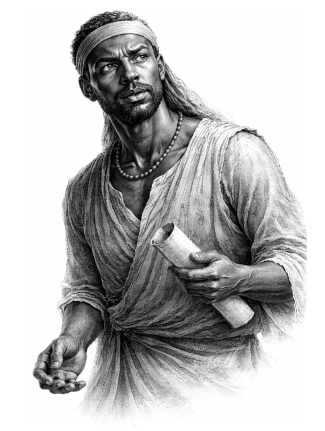
His rap is intellectual and incisive. His language is sharp, analytical, and poetic. He speaks with the cadence of a man who has spent his life observing from the margins of power, only to discover that his observations hold no authority in moments of judgment. The Scribe’s verse exposes the collapse of logic when confronted with divine reality. He admits that the laws he preserved cannot shield the nation from consequence. He confesses that knowledge without wisdom becomes a prison.
Emotionally, the Scribe represents denial turning into realization. He begins as someone clinging to the belief that Egypt’s order will hold, that the plagues are anomalies, that the empire is too established to fall. But as each plague erases another layer of stability, he becomes the voice that
names the intellectual and cultural disintegration of Egypt. His transformation mirrors the collapse of a worldview built on false assumptions and inherited arrogance.
Vocally, the Scribe blends rhythm with clarity. His rap lines must sound precise, almost academic, but infused with rising panic. He speaks like a man who once believed he understood the world, now discovering that truth has escaped the boundaries of logic and language. His delivery is crisp, fast, and expressive, reflecting the tension between knowledge and fear.
Symbolically, the Egyptian Scribe represents:
- The collapse of ideology
- The failure of human record to capture divine acts.
- The intellectual awakening of a society in crisis.
- The unraveling of structured power.
- The limits of empire’s stories
He is the archivist of Egypt’s glory, now forced to document its downfall. His presence enriches the plagues sequence by adding layers of meaning
that stretch beyond physical suffering. Through him, the musical explores the psychological and cultural devastation of Egypt. He speaks
for those who believed empire would last forever and now must face the truth that no earthly power can withstand divine justice.
Dramatically, the Scribe contrasts the Artisan and Soldier. Where the Artisan speaks from guilt and the Soldier from disillusionment, the Scribe speaks from the collapse of certainty. Together, they create a three dimensional portrait of Egypt’s inner world, revealing the spectrum of human reaction within a society facing irreversible judgment.
The Egyptian Scribe is a reminder that the stories nations tell themselves can blind them to the truth. He is the voice of a world built on fragile
belief. He is the sound of intellect cracking under the weight of revelation.
He wrote Egypt’s history.
Now he watches that history burn.