
Egyptian Soldier
The Egyptian Soldier represents the frontline heart of Pharaoh’s military might. He is the man who carried out the commands of empire without question, who marched in perfect rows, who believed in Pharaoh’s divinity, and who trusted the stability of a world built on discipline and fear. In “Ashes in the Throne Room,” the Soldier becomes the voice of a warrior whose certainty has shattered, leaving him clutching the ruins of a collapsing identity.
Unlike the Egyptian Guards, who move with rigid ritualistic precision, the Soldier is given an individual voice, a glimpse into the humanity beneath the armor. His rap and spoken-word lines expose the emotional cost of being the enforcer of another man’s ideology. He is not merely a cog in the engine of oppression. He is a man who has lost faith in the very foundation of his role.
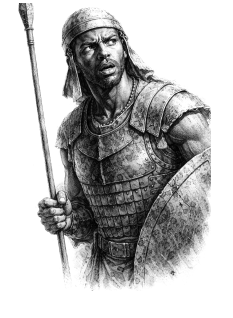
The Soldier has lived his life believing that strength preserves order, that Egypt’s gods protect their own, and that Pharaoh’s lineage is unshakable. Yet when the plagues strike, he discovers that no spear, no formation, no battle cry can defend against the divine. His training becomes useless. His
pride becomes hollow. His certainty dissolves into fear.
His verse in the musical is raw, rhythmic, and desperate. It strips away the militaristic armor of the Egyptian Guards and reveals the inner turmoil of someone who once believed he fought for the glory of a divine ruler. Now he sees that he was only holding up a fragile myth. His words reflect disgust at the system he served, sorrow for the devastation around him, and bewilderment at the rapid collapse of a world he thought invincible.
Vocally, the Soldier delivers with force and emotional honesty. His rap is heavy, grounded in breath, shaped by disbelief and anger. He performs like a man whose body still remembers battle rhythm but whose mind no longer trusts the war. His voice often breaks at the edges, mirroring
Egypt’s unraveling strength.
Choreographically, the Soldier’s movements are less precise than the Guards. He moves with the uncertainty of a man who no longer knows where to march. His gestures are sharper, more impulsive, more expressive of fear and internal conflict. He symbolizes the breakdown of the disciplined machine that once defined Egyptian power.
Symbolically, the Egyptian Soldier represents:
- The disillusionment of those who uphold oppressive systems.
- The collapse of militaristic identity.
- The breaking of blind loyalty.
- The recognition of divine power beyond human control.
- The guilt of having enforced a world now revealed as unjustries.
He gives voice to the emotional fallout of judgment. Through him, the audience witnesses not only Egypt’s political collapse but its spiritual and psychological destruction. He stands as a warning: a system built on fear will eventually consume those who defend it.
In the narrative structure, the Soldier completes the trio of Egyptian voices:
- The Artisan speaks of cultural guilt.
- The Scribe speaks of intellectual collapse.
- The Soldier speaks of militaristic disillusionment.
Together, they reveal the full human cost of Pharaoh’s pride.
By the time the Red Sea opens, the Soldier is no longer a man of war. He is a man trying to understand a world that has betrayed him. His final moments onstage mirror the fate of Egypt’s army: charging forward into the unknown, convinced of Pharaoh’s order, unaware that the sea has already chosen its judgment.
He embodies the tragic truth that those who fight hardest for empire often fall hardest beneath its ruins.