
Israelite Ensemble
The Israelite Ensemble is the collective soul of the musical. They are the voice, breath, memory, fear, and rising courage of a people learning to stand again after centuries of oppression. Their presence threads through every scene, shaping the emotional and spiritual landscape of the story. They do not simply witness the Exodus. They embody it. They give it fire, rhythm, lament, and celebration.
From the opening moments of “Exodus,” the Ensemble introduces the sound of a nation groaning beneath bondage. Their whispers tremble with exhaustion. Their chants pulse with the ache of survival. Their harmonies carry the deep, ancestral longing for freedom. They provide the grounding on which Moses, Miriam, and Aaron rise. Without their suffering, there is no story. Without their song, there is no deliverance.
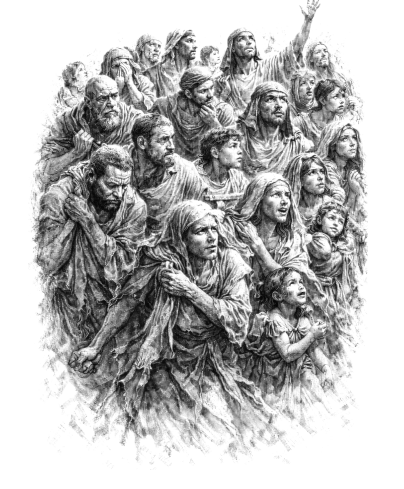
The Ensemble’s sound evolves as the musical progresses. In early scenes, their voices are subdued, breath-heavy, and crushed beneath fear. Their chants echo like prayer smothered by chains. But as Moses steps into his calling, as the plagues unfold, and as hope presses against despair, their sound gradually grows. Their harmonies strengthen. Their rhythm sharpens. Their whispers become chants. Their chants become declarations. Their declarations become the thunder of a rising people.
Choreographically, the Israelite Ensemble moves with organic flow, grounded in African diaspora movement, communal shapes, and ritual gesture. Their bodies express the weight of labor, the trembling of fear, the panic at the sea, and the ecstatic freedom on the other side. They sway as one body or splinter into clusters of grief and urgency. They form the chains of bondage, the current of the Nile, and the trembling breath of a nation waiting for God to move.
Emotionally, the Ensemble represents the heart of Israel’s journey. Their reactions open windows into communal trauma: mothers clutching children during the decree, men whispering fear in the palace shadows, families trembling as plagues shake Egypt, and an entire nation breaking under the pressure of impossible circumstances. Their panic at the Red Sea is the panic of humanity facing the unknown. Their celebration in “Deliverance” is the joy of people who discovered not only freedom, but identity.
Thematically, the Israelite Ensemble symbolizes:
- A people shaped by suffering yet strengthened by hope
- The generational memory that refuses to die
- The courage that grows in community
- The spiritual hunger for God’s intervention
- The transformation from silence to voice
- The rebirth of identity on the far shore
Their unity is not uniformity. Each voice matters. Each movement contributes. Their collective presence reveals that deliverance is never the work of one leader, but of an entire community rising after centuries of being pushed down.
By the time “Here We Go” arrives, the Ensemble stands fully transformed. No longer slaves. No longer shadows. They are a nation with breath, rhythm, and destiny. Their voices in the finale feel like thunder breaking across the earth. Their harmonies carry triumph without erasing the memory of suffering. Their movement reflects the steps of a people who know what it means to walk through fear, through fire, and through water toward promise.
The Israelite Ensemble is the heartbeat of the show.
They carry the lament.
They carry the faith.
They carry the transformation.
Their journey is the Exodus.
And their sound becomes the sound of freedom itself.