
Pharaoh’s Daughter
Raised in the luxury of the palace, Pharaoh’s Daughter grows up surrounded by wealth, ceremony, and rigid hierarchy. She is taught that her father’s word is absolute and that the gods have ordained Egypt’s supremacy. Yet beneath her royal composure lies a heart that sees the world differently. Where others see a slave child marked for death, she sees a human life worth saving. Her defiance is not reckless. It is courageous. She stands at the fragile place where compassion dares to resist tradition.
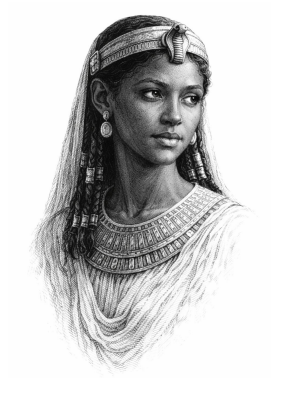
Pharaoh’s Daughter embodies the moral conflict of those who benefit from an unjust system but refuse to be silent within it. Her rescue of Moses is not an act of rebellion for rebellion’s sake. It is an act of conscience born from the recognition that innocence should not be sacrificed to preserve power. In that moment, she becomes a bridge between worlds. She becomes the person who holds the future liberator in her arms long before anyone imagines what he will become.
Vocally, Pharaoh’s Daughter is a soprano with a lyrical, fluid tone. Her songs and melodic lines carry an air of grace, gentleness, and depth. Her musical presence contrasts the percussive tension of the Hebrews and the militaristic force of the Egyptians. She sings with warmth rather than authority, tenderness rather than triumph. Her voice mirrors the river where she finds Moses: quiet, flowing, and full of hidden power.
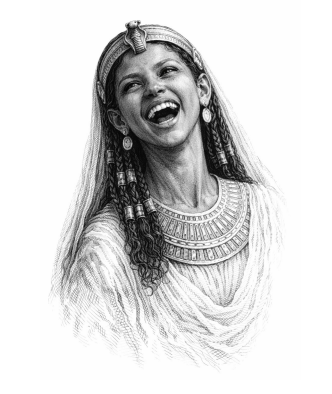
Her relationship with Moses, though not explored extensively in Scripture, is given emotional space in this musical. She becomes a maternal figure whose influence shapes Moses’s early view of compassion, justice, and belonging. She is the one who teaches him how to carry himself with dignity. She is the first to see him not as Hebrew or Egyptian, but simply as a child with a future. Her love is what allows Moses to grow into both the man of the palace and the man of destiny.
Symbolically, Pharaoh’s Daughter represents the river’s mercy. She is the embodiment of unexpected grace. She stands as proof that liberation can begin with one courageous choice made in quiet defiance. She is the one who interrupts a cycle of violence by choosing to nurture instead of destroy. Her presence reminds the audience that sometimes deliverance begins not with a miracle, but with one human heart refusing to obey injustice.
Her story also exposes the emotional cost of compassion within an oppressive system. Though she saves Moses, she must do so in secrecy, knowing that the palace would not approve. Her love becomes both her strength and her burden. Yet she never apologizes for her choice. She protects Moses with a fierceness that foreshadows the protective love that will one day surround him from the Hebrew nation.
In this musical, Pharaoh’s Daughter is not a passing character. She is the woman who sets the story in motion. Without her mercy, Moses would not survive. Without her defiance, the Hebrews would not have a deliverer. Without her courage, history would be different.
She is the quiet hinge on which the door of deliverance swings open.
She is the compassion that challenges empire.
She is the mother who loved a child the world tried to erase.
Pharaoh’s Daughter stands as a reminder that even in the darkestsystems, light can rise from unexpected places.