
The Last Line
“The Last Line” is the final musical breath of Pharaoh. It is not a battle anthem, not a scream, not a command. It is the quiet confession of a man who realizes that all the power he chased has left him with nothing. The song follows the collapse of the miracle corridor. The Israelites are gone. The sea is trembling. The wind has swallowed every voice but his. Pharaoh stands alone in a desolate hush where the Red Sea meets the sky.
This number must feel like a requiem spoken by the last survivor of a ruined world. The music is intentionally sparse. Only ambient wind, a single low cello note, and the faint echo of water moving behind him. No rhythm. No drums. No trace of the militaristic force that carried him until now. The score should sound like the silence after judgment has finished its work.
Pharaoh does not sing with melody. His voice falls in fragments, half spoken, half sung, as if each word is a stone he must place down before the sea takes him. His tone is low, solemn, almost tender, stripped of pride and stripped of fury. This is the voice of a father whose grief hollowed him, a king who sees the truth too late.
The moment must feel suspended in time. Lighting should isolate him in a thin, dim column while the world behind him shakes in preparation for the sea’s return. His words are delivered slowly, each line echoing his life’s unraveling. There is no orchestra to catch him. No guards to answer. No gods to defend him. Only the sound of the wind and the weight of the final thought he will ever speak.
The last chord does not resolve. It simply exists, trembling in the air as the sea rises to reclaim him. A deep, earthlike rumble signals the collapse of the walls. The lights vanish at the exact moment the sea falls.
“The Last Line” is Pharaoh’s final acknowledgment that the story was never about his glory or his power. It is the quiet truth of a man who sees himself clearly for the first time.
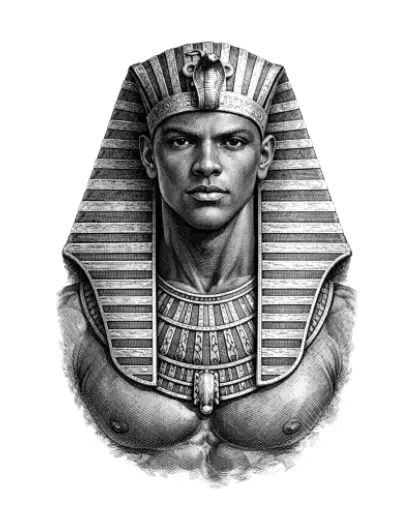
PHARAOH – Male bass (solo spoken-sung lead)
Vocal tone: deep, soft, slow, and weighted with grief. Pharaoh is the only voice in this piece. His delivery is not melodic but spoken-sung, with each line falling like a heavy stone. His tone should evoke the warmth of Gregory Porter mixed with the solemn authority of Morgan Freeman. There is no projection, no power, no command. Every word must sound like it is carried on the last breath of a man who finally understands the cost of his pride. His voice defines the entire emotional landscape.
NO ENSEMBLE VOICES
There are no guards, no chorus, no echoes from Israel. The musical world has emptied. This is intentional. Pharaoh’s isolation is the heart of the scene. The absence of any supporting vocals emphasizes the silence of a king who once spoke with the weight of nations but now stands alone before the sea.
INSTRUMENTAL PRESENCE – Solo cello + ambient wind (non-vocal)
- While not singers, the cello and the wind function like ghostly companions to Pharaoh’s final confession.
- The solo cello holds a low, trembling note throughout most of the piece, acting as Pharaoh’s emotional spine.
- The wind FX create a sense of the sea preparing to fall, mirroring the emptiness around him.
- Their presence does not speak. They underscore his ending.
NO CHOIR, NO HARMONIES, NO CALL-AND-RESPONSE
This must feel like a man speaking his last thought to an empty world. “The Last Line” Musical Style & Direction
“The Last Line” is a minimal, sorrow-soaked musical coda built entirely around Pharaoh’s final spoken-sung confession. The score must feel like the last breath of a collapsing empire, stripped of rhythm, stripped of command, stripped of everything but the sound of wind and a single cello holding the weight of his grief. Nothing in the music should compete with Pharaoh. The power of the moment comes from absence, emptiness, and the quiet recognition of what has been lost.
The musical palette remains spare throughout the first portion of the piece. Wind FX drift in and out like the sea inhaling before the fall. A solo cello holds long, low tones that tremble beneath Pharaoh’s voice. No percussion, no ensemble, no harmony. The sound must feel hollow, cold, and stretched across a vast, dying landscape. Pharaoh’s voice enters in this void, speaking lines that fall heavy and low, creating the sense that he is singing into an empty world.
The final half of the number shifts. The orchestra falls entirely silent. Only ambient wind remains. The stage becomes driven not by music but by choreography and lighting tied directly to each bar of the remaining score. This section is built around a ritual stomp sequence performed by the last of Pharaoh’s guards, representing the dying heartbeat of his power.
- Each bar ends with a single, heavy stomp from paired dancers positioned symmetrically across the stage. On the first bar, the far-left and far-right pairs stomp in unison, and their lights black out immediately.
- On the next bar, the next inward pair stomps, and their lights black out.
- Each bar continues this inward collapse, eliminating the guards two at a time.
- The visual field narrows steadily until only Pharaoh remains illuminated in a thin, lonely strip of light.
The stomp rhythm is not part of the musical score. It is performed in dry stage sound, without added percussion. The absence of instruments during this sequence makes each stomp sound brutal and final, like the last echoes of an army that no longer exists. The blackout of each pair underscores the shrinking world around Pharaoh as his power, his legacy, and his identity disappear in concentric circles.
Once the guards have vanished into darkness, Pharaoh sits at his throne alone. No music beneath him, no dancers, no movement. Only him and the cold wind remain, then the light finally goes out on him alone.
The piece ends with a full blackout the instant the rumble hits its peak.
“The Last Line” must feel like a funeral for a king who finally understands himself at the moment the world closes over him.
[PHARAOH – Male bass. Vocal tone deep, warm, and weighted, like Gregory Porter blended with Morgan Freeman. Every line should fall slowly, as if pulled downward by grief. No true melody, only spokensung phrasing delivered with heavy breath and soft resonance.]
[MUSIC – Almost no music. A single low cello note sustains beneath him, trembling slightly. Sparse wind FX drift through the space, cold and hollow. The lighting dims to a narrow, isolating pool around Pharaoh. The world feels empty, stripped of soldiers, power, and purpose.]
[PHARAOH:]
[(spoken-sung, quiet, intimate mic tone)]
The waves rose up, From out the sea.
They waited.
Then raged.
To set them free.
This was never about Slaves or prophecy.
This was always about… me.
[CLOSING SOUND – A deep, slow-building rumble from below the stage. The parted sea collapses in a massive crashing FX cue. On the impact, the lights cut instantly to full blackout. Pharaoh is gone.]